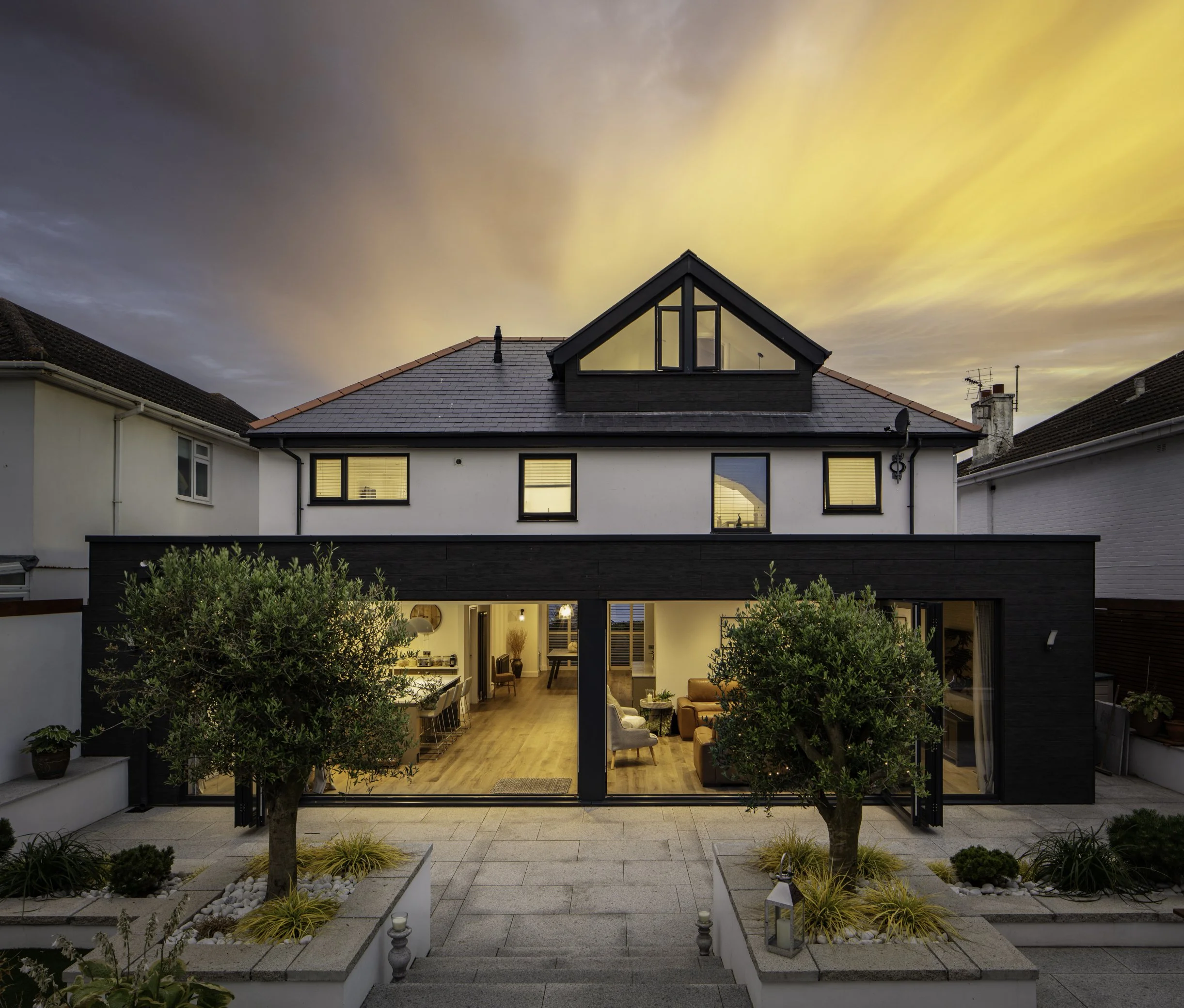
House Extension Architects for South Wales and South West
Making the Most of Your Home
Dennis Hellyar Architects are RIBA chartered house extension architects serving homeowners across Cardiff, the Vale of Glamorgan, Swansea, Bristol and the wider South West. We design house extensions that make the most of your existing home, respond to its character and get through the planning process. From the first conversation to planning approval and beyond, we make the whole process straightforward.
Extending your home is one of the most significant investments you will make. Done well, it adds space, improves how your home works and adds real value to your property. Done badly, or without the right advice, it can become a source of stress, delay and unexpected cost.
As architects with over a decade of experience across South Wales and the South West, we have helped hundreds of homeowners navigate the process from first idea to finished extension. We know the planning authorities we work with, we understand what makes a well-designed extension and we give clear, honest advice at every stage. Our job is to make a complex process feel manageable.
Whether you are planning a modest single-storey addition or a substantial two-storey extension, we bring the same care, expertise and local knowledge to your project.
House Extension Projects We Have Delivered
Here is a selection of residential extension projects we have delivered for homeowners in South Wales and the South West. Each one started with a conversation about what was possible.


Types of House Extension We Design
Every home is different, and every extension brief is different. Here are the most common types of house extension our architects design across South Wales and the South West:
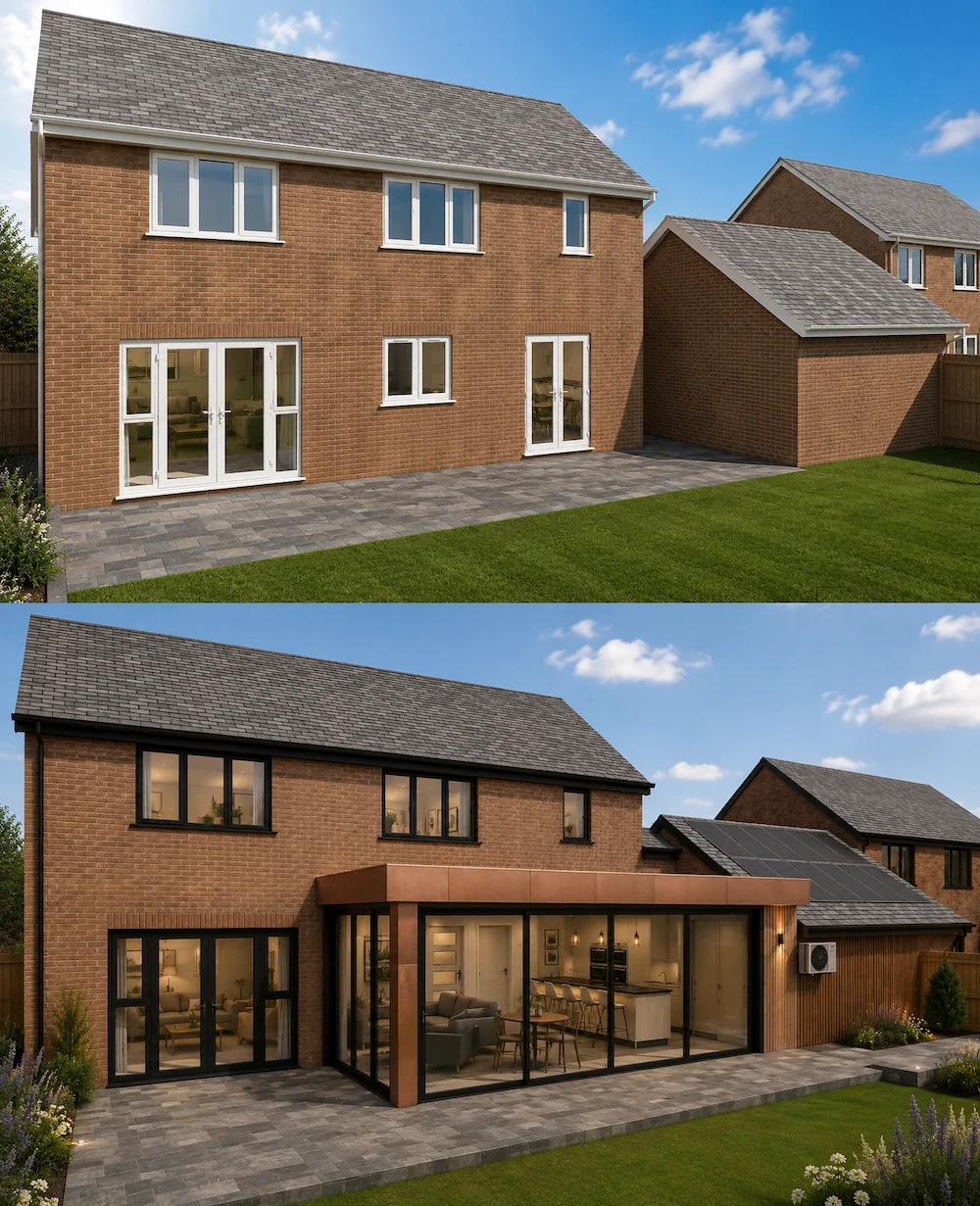
Rear Extensions
Rear extensions are the most popular type of house extension we design. They typically extend the kitchen and living space at the back of the house, opening up the ground floor and creating a better connection to the garden. A well-designed rear extension can transform how a family uses the ground floor of their home. We design rear extensions for all property types across the region, from Victorian terraces in Cardiff and Bristol to interwar semis in Swansea and modern detached houses across the Vale of Glamorgan.
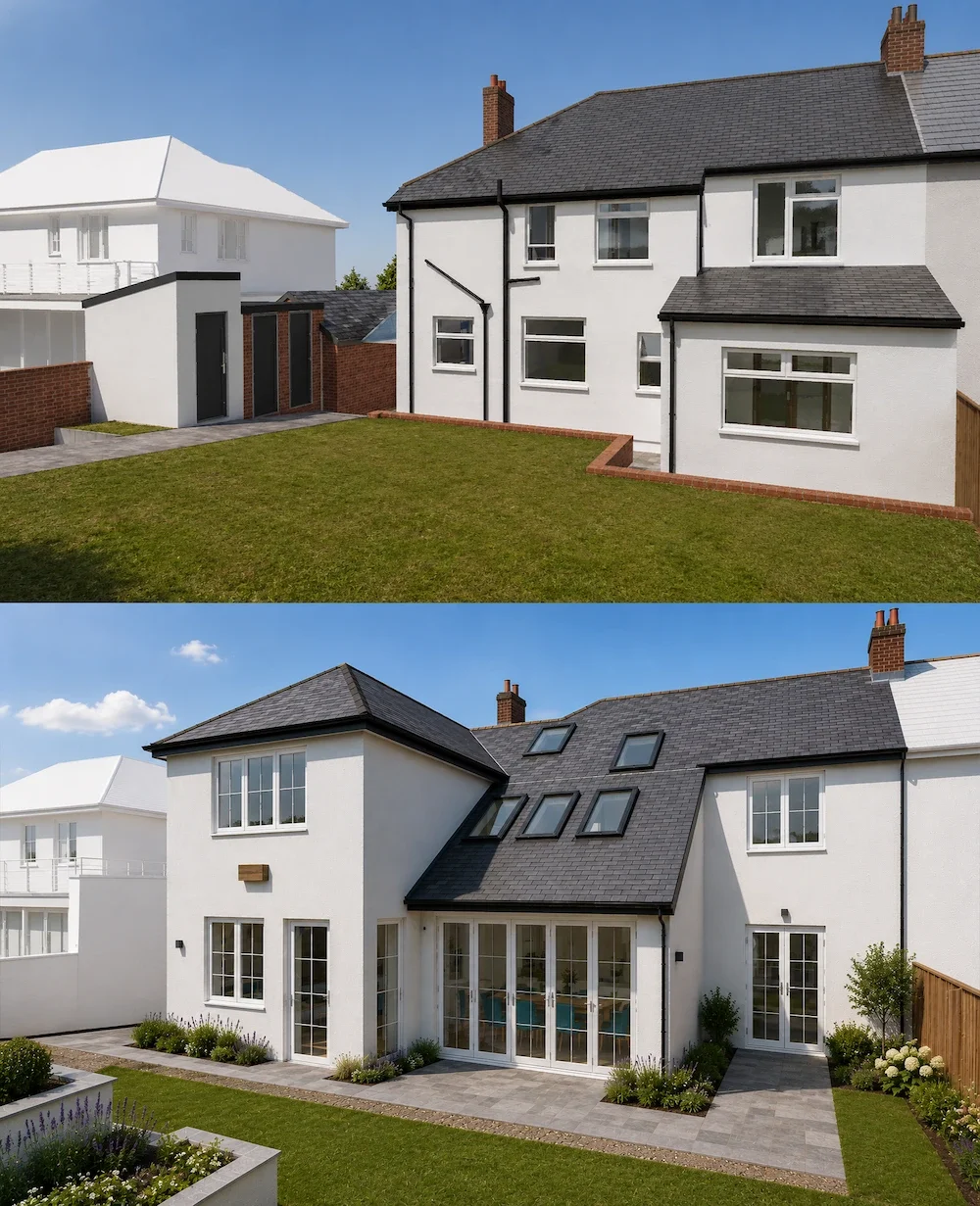
Wrap-Around Extensions
A wrap-around extension combines a rear extension with a side return to create a large L-shaped addition to the back and side of the house. It is the most transformative type of single-storey extension and can dramatically increase the ground floor space of a terraced or semi-detached property. Wrap-around extensions require careful design to manage the relationship with neighbouring properties and to satisfy planning requirements.
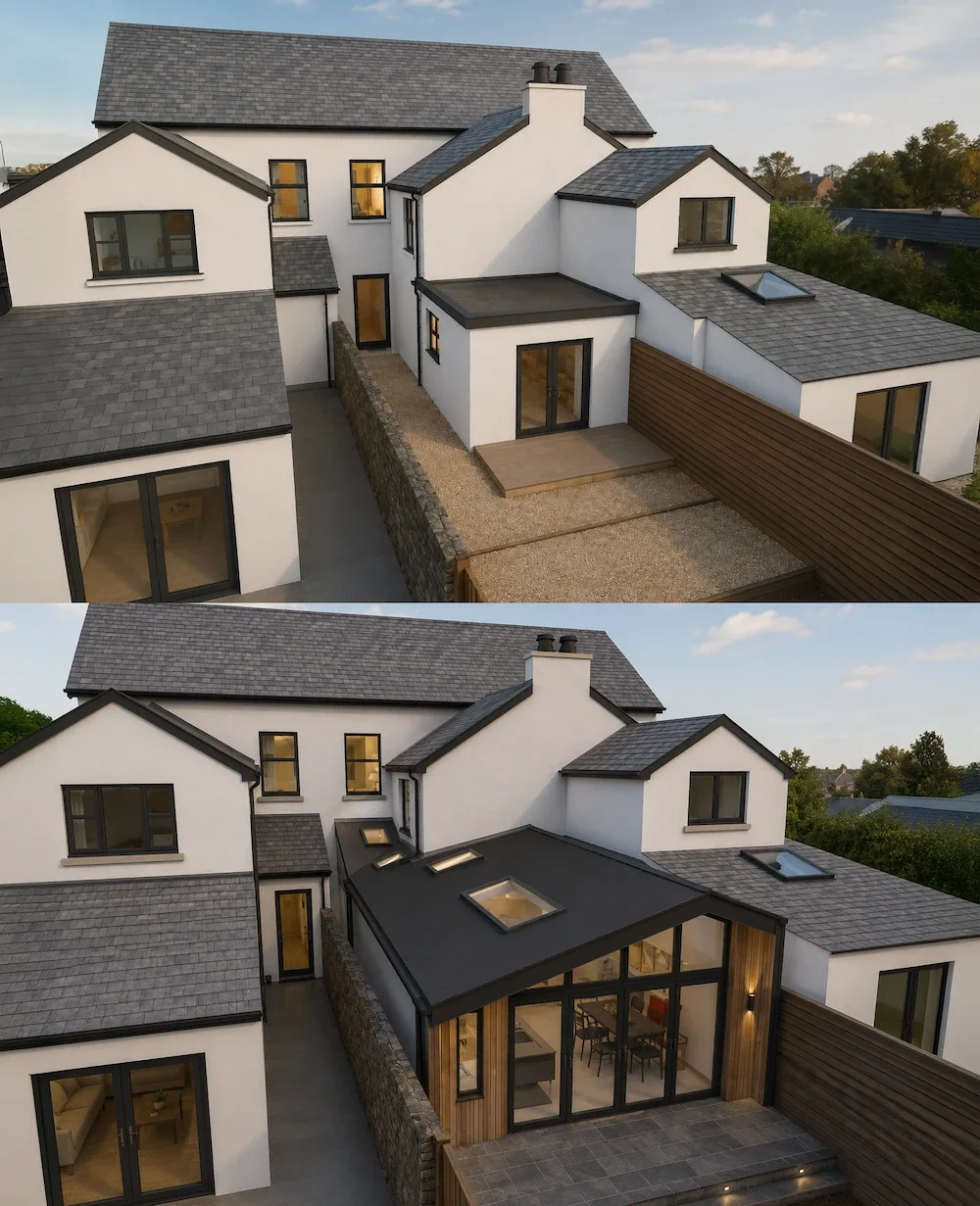
Infill Extensions
Infill extensions fill in the narrow gap that runs alongside many Victorian and Edwardian terraced houses, adding width to a ground floor room that is otherwise awkwardly proportioned. They are particularly common in inner Cardiff, Penarth and Bristol, where the terrace housing stock often includes a side return. A side return extension can transform a dark, narrow kitchen into a bright, open kitchen-diner without extending into the garden.
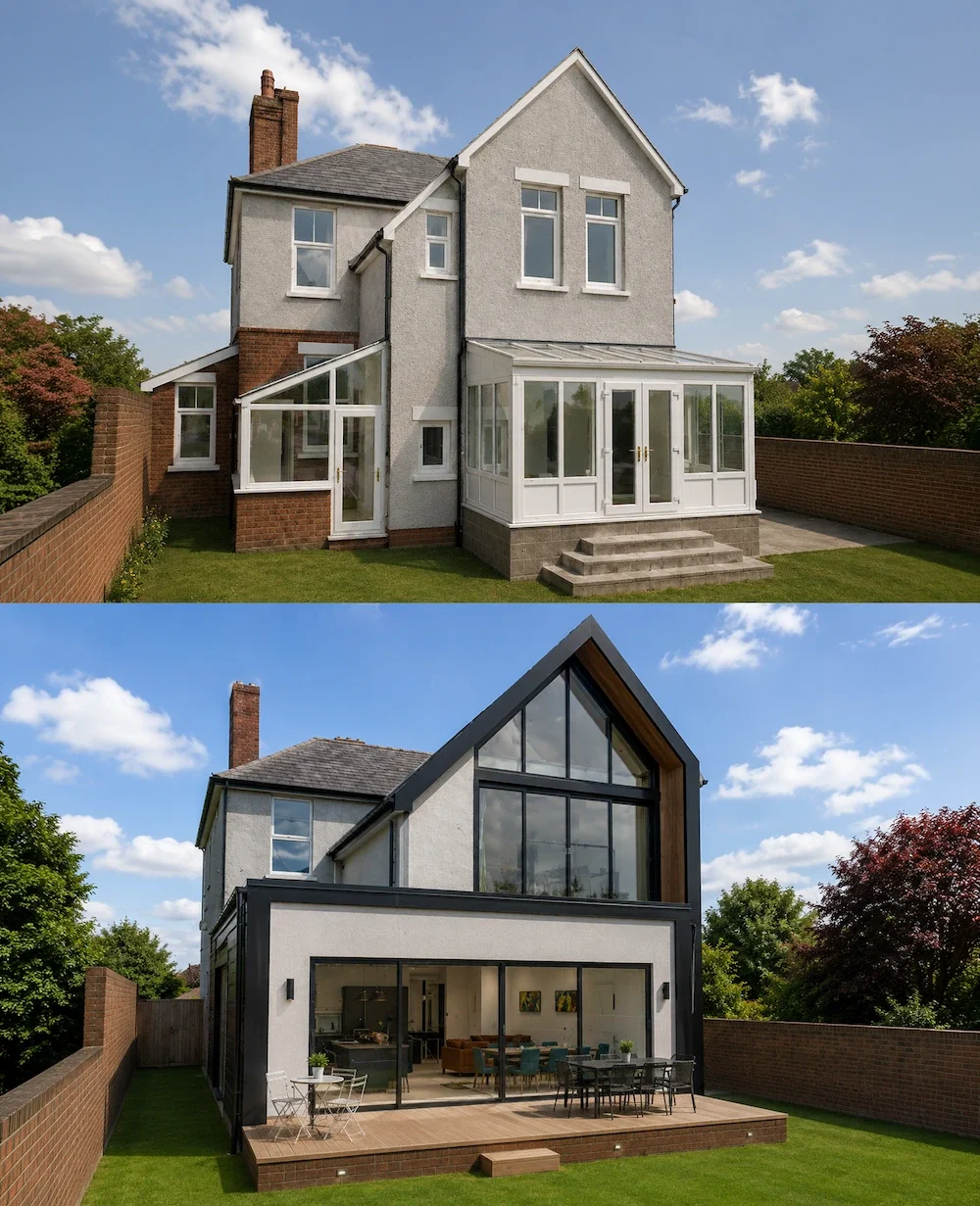
Two-Storey Extensions
Two-storey extensions add space on both the ground and first floors, making them the most efficient way to increase the footprint of your home. They are often used to add a bedroom and bathroom above a ground floor extension, or to create a substantial kitchen and dining space with a bedroom above. Two-storey extensions typically require full planning permission and careful design to ensure they are proportionate to the existing house and acceptable to the local planning authority.
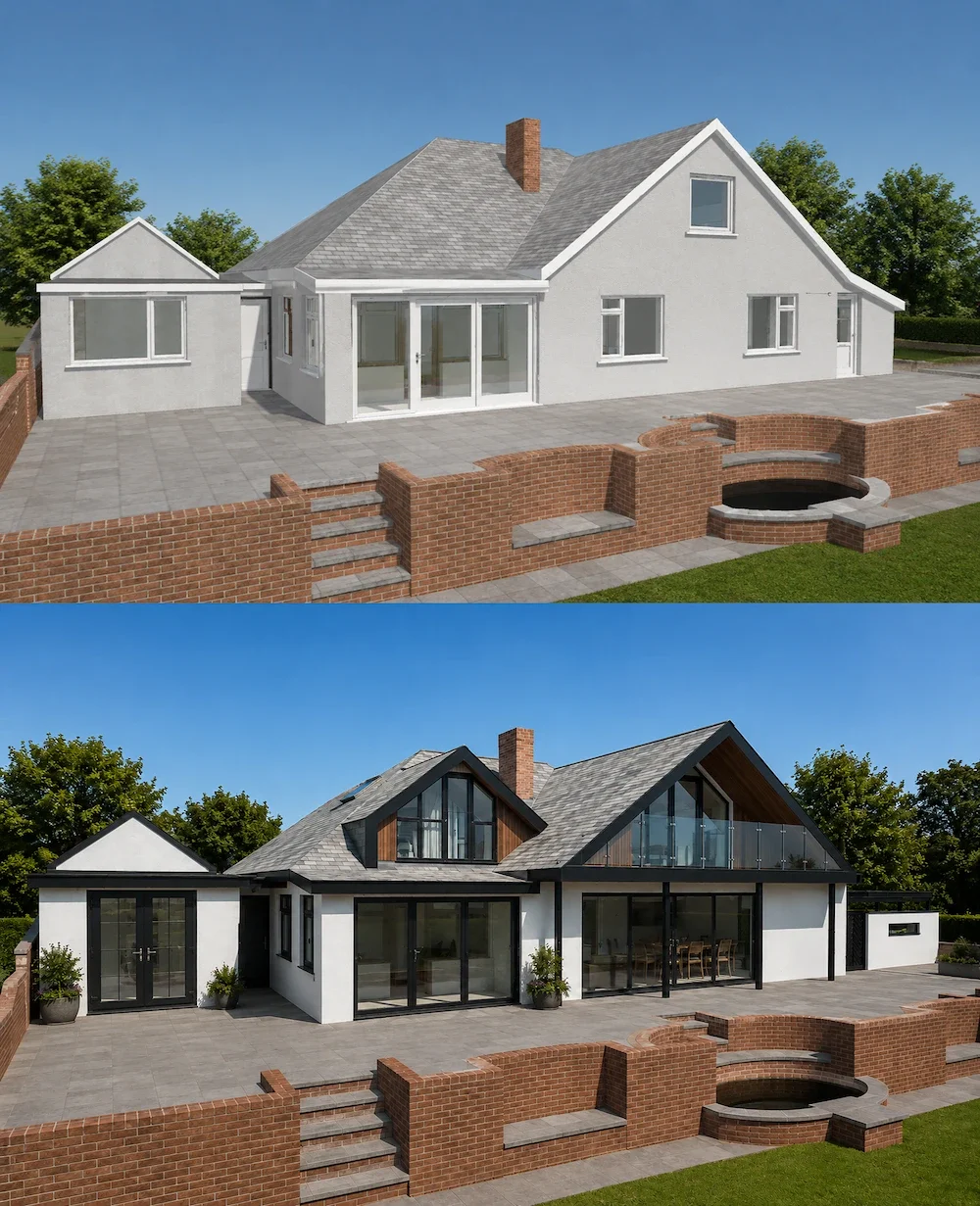
Loft Conversions
Converting a roof space into a usable room is one of the most cost-effective ways to add space to a house without extending outward. We design loft conversions across South Wales and the South West, including dormer extensions, hip-to-gable conversions and mansard roof designs. Most loft conversions require planning permission, and the design needs to balance internal space requirements with the external appearance of the roof in the context of the street.
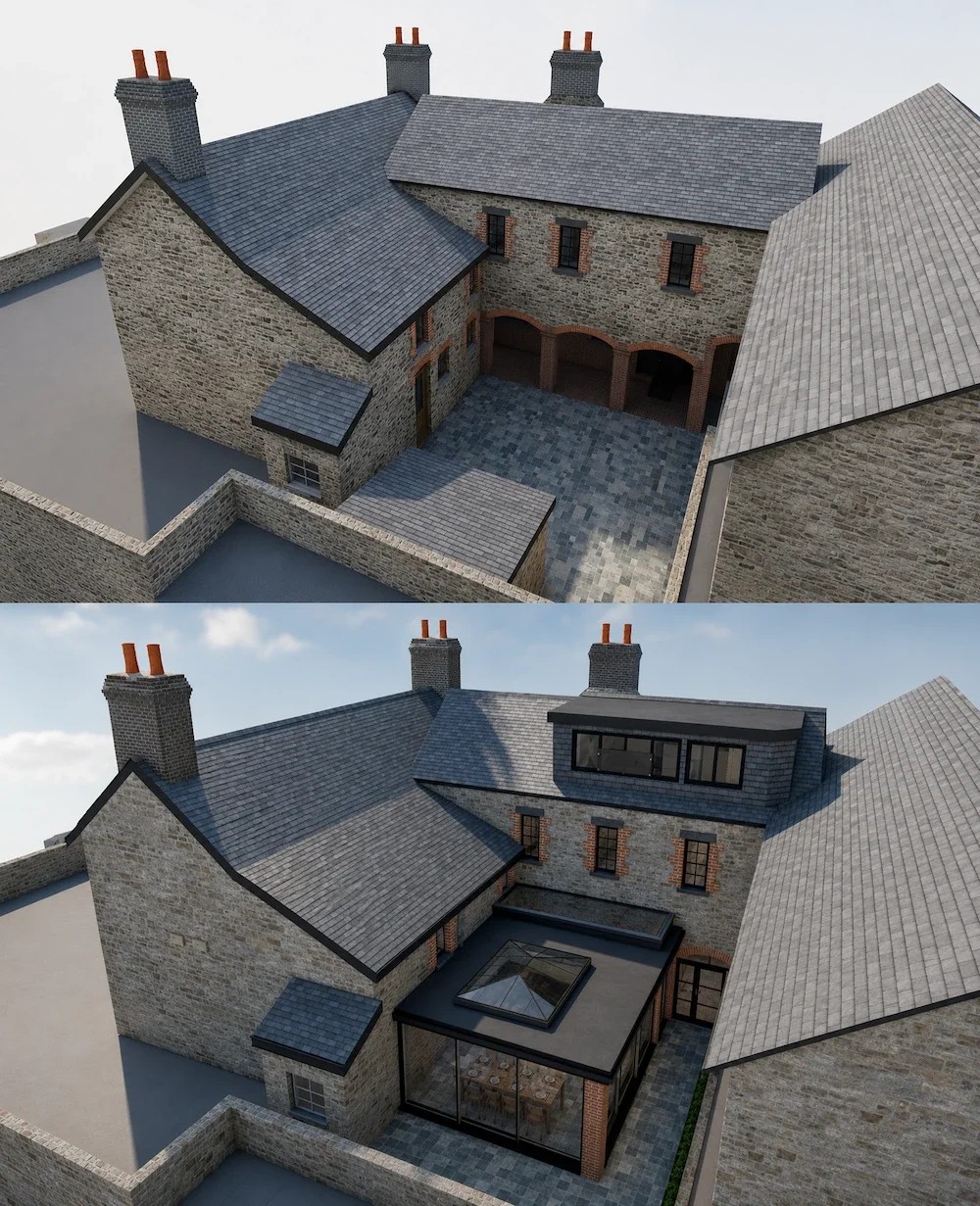
Extensions to Period Properties and Conservation Areas
South Wales and the South West has a number of conservation areas, particularly in rural areas and parts of the city centres, where extensions and alterations are subject to stricter design requirements and reduced permitted development rights. We design extensions in conservation areas with care and a thorough understanding of the council’s expectations for development in sensitive historic settings.
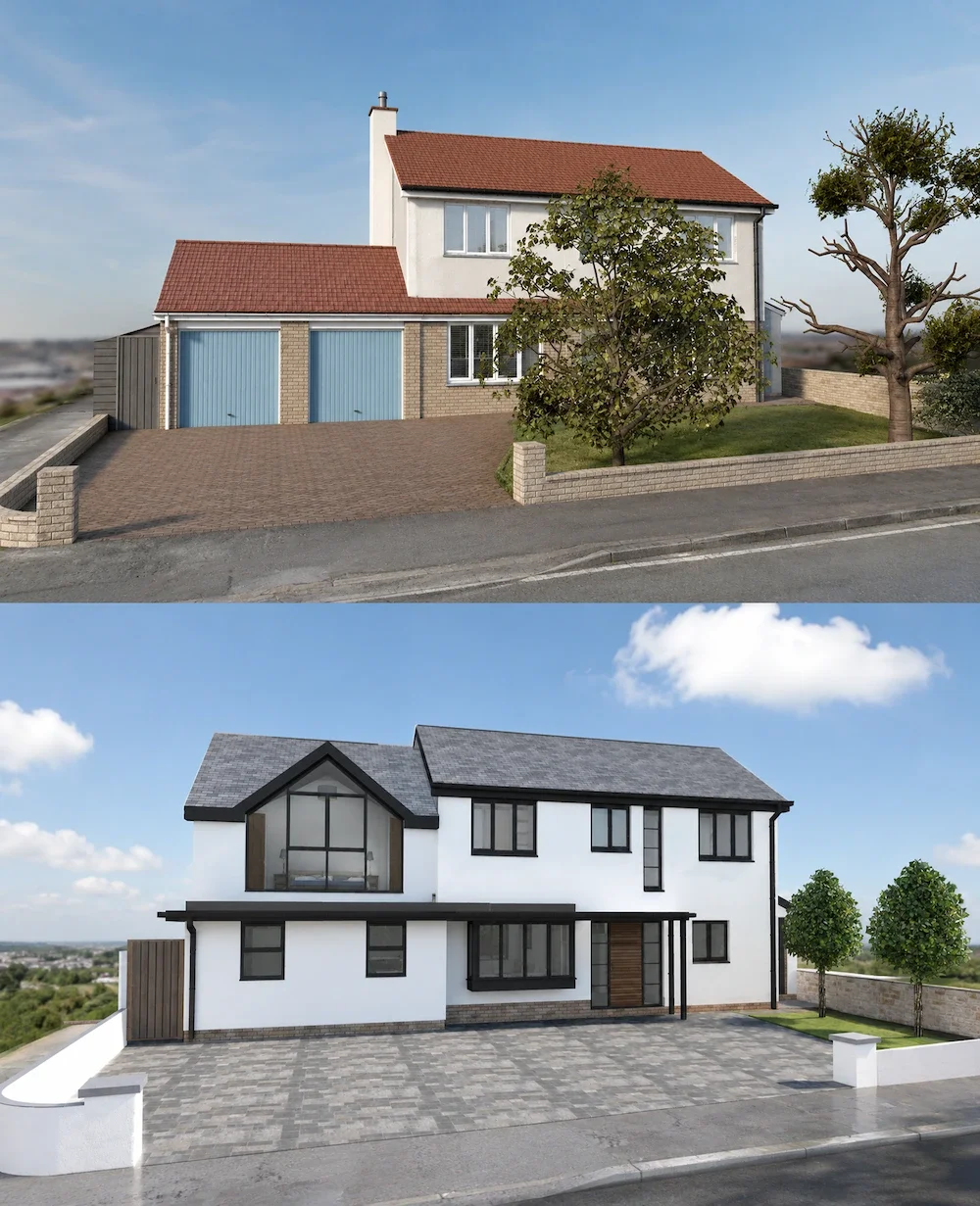
Over-Structure Extensions
Some properties have an existing single-storey element, such as a garage, utility room or flat-roof extension, that can be extended upwards to add a room at first floor level without increasing the ground floor footprint. Over-structure extensions require careful structural assessment and planning consideration, but they are an efficient way to add bedroom or bathroom space where ground floor expansion is not possible.
Award-Winning Architectural Firm
Founded in 2013 after 20 years at large practices, Dennis Hellyar Architects brings the rigour of a bigger firm with the personal service clients value most. We are registered with the Architects Registration Board and hold Certified Passive House Designer accreditation, making us well-placed to advise on energy performance and sustainability across all project types.
From residential extensions in Pontcanna to a £27M social housing regeneration scheme for Cardiff City Council, our track record speaks for itself. Our Cwrt Parc development won the Best Social Housing Award at the Building Excellence Awards 2020.

How Our Architects Work With You
If you have not worked with architects before, here is how our process typically works from first contact to completed project. Not every client needs all of these stages. We are equally happy to provide exactly the level of service your project requires.
Step 1: Initial conversation
We start every project by understanding what you are trying to achieve, how you use your home and what your budget and programme look like. The more we understand at the start, the better the design we can produce.
Step 2: Site visit and feasibility
We visit your property, review its planning history and assess any constraints that will affect the design, whether that is a conservation area designation, a listed building status, a tight boundary condition or a complex relationship with a neighbouring property.
Step 3: Design development
We design your extension in close collaboration with you, developing options and refining the preferred scheme until the design is exactly right. We use 3D models and visualisations so you can see and understand the proposal before anything is submitted.
Step 4: Planning drawings and submission
We prepare a professional set of planning drawings and supporting documents and manage the submission to the relevant local planning authority on your behalf. Our knowledge of planning authorities across South Wales and the South West means applications are prepared to a standard that gives your project the best possible chance of approval.
Step 5: Building regulations and construction
for clients who want full support, we can take the project through building regulations and construction, preparing technical drawings, managing the tender process and administering the building contract. We remain your single point of contact throughout.
Ready to get started? An initial conversation with our architects costs nothing and will give you a much clearer picture of what your home extension could achieve.
Areas We Cover for House Extensions
We design house extensions and manage planning applications for homeowners across a wide area of South Wales and the South West. Our studio is based in Barry, Vale of Glamorgan, and we work regularly across the following areas:
Cardiff
All residential neighbourhoods, including conservation areas in Pontcanna, Roath and Canton and standard residential zones across the city. In-depth knowledge of Cardiff Council planning policies.
Vale of Glamorgan
Our home patch, covering Barry, Penarth, Cowbridge, Llantwit Major, Dinas Powys and the rural Vale, including Heritage Coast and conservation area properties.
Swansea
Covering the city, Mumbles, Gower, Sketty, Uplands and the surrounding areas, with experience of City and County of Swansea planning policies and Gower AONB requirements.
Bristol
All residential areas, including conservation areas in Clifton, Redland and Cotham and properties subject to Article 4 directions. Knowledge of Bristol City Council's planning policies and design guide.
Wider South Wales and the South West
Including Newport, Monmouthshire, Bridgend, Neath Port Talbot, North Somerset and South Gloucestershire.
Why Choose Dennis Hellyar Architects as Your House Extension Architects
There is no shortage of house extension architects working across South Wales and the South West. Here is why our clients choose us and why they come back.
RIBA Chartered Practice and ARB registered: professional accreditations that are your assurance of quality, accountability and ongoing professional standards.
Over a decade of house extension experience across the region: we have designed extensions for all property types, in all planning contexts, across Cardiff, the Vale of Glamorgan, Swansea, Bristol and beyond.
Strong track record with local planning authorities: we know the planning authorities we work with and we prepare applications that are well-targeted and well-presented. We do not prepare applications we do not believe in.
Practical, buildable design solutions: we design extensions that can be built within your budget and that will perform well over time. Good design and buildable design are not in conflict: they are the same thing done properly.
Personal service throughout: you work directly with experienced architects from the first conversation to planning approval and beyond. Your project is never passed to juniors or handled at a distance.
Honest about costs and timescales from the start: we give you a clear fee proposal before we begin and a realistic programme from the outset. No surprises.
Local knowledge that makes a difference: based in Barry, we know the planning policies, design expectations and planning officer teams across the region in a way that a practice working from further afield simply cannot match.
Why Use House Extension Architects Rather Than a Draughtsperson?
It is a fair question. Planning drawings for a simple extension can be produced by a draughtsperson or a technician, and their fees may be lower than an architect's. So why hire house extension architects?
Design quality matters
An architect does not just draw what you ask for. We assess your property, understand how it works as a whole, and design an extension that improves the building rather than just adding to it. A poorly designed extension can feel disconnected from the existing house, reduce natural light in rooms it was meant to improve, or create awkward proportions that make both the old and new parts of the house feel worse. Getting the design right requires design skill, not just drawing ability.
Planning knowledge is not the same as drawing ability
Preparing a planning application requires an understanding of planning policy, conservation area requirements, permitted development rules and what a specific local planning authority is likely to accept or reject. House extension architects bring that knowledge to every application we prepare. A draughtsperson may produce accurate drawings, but they may not know how to frame a proposal to maximise its chances of approval, or how to respond when a planning officer raises concerns.
RIBA chartered architects are accountable
When you hire a RIBA chartered practice, you are working with an organisation that is accountable to professional standards. RIBA chartered status requires ongoing compliance with quality management, professional conduct and client care standards. If something goes wrong, there is a formal complaints and arbitration process. That accountability does not exist with unregulated draughtspersons or architectural technologists.
The cost difference is often smaller than it appears
Architect fees for a house extension are a small percentage of the total project cost. The difference in fees between a RIBA chartered house extension architect and a cheaper draughtsperson is typically modest in the context of a £50,000 to £150,000 extension. But the difference in outcomes, in design quality, planning success and construction delivery, can be significant. We are transparent about our fees from the outset so you can make an informed comparison.
Planning Permission for House Extensions: What You Need to Know
One of the first questions most homeowners ask us is whether their extension will need planning permission. The answer depends on the size, type and location of the extension and the specific circumstances of your property. Here is a plain-language guide to how planning works for house extensions across our service area.
Permitted development rights
Many house extensions can be carried out under permitted development rights, which allow certain types of development to proceed without a formal planning application. Permitted development rules set specific limits on the size, height and position of extensions, and allow rear extensions of up to 4 metres for detached houses and 3 metres for other house types without planning permission, subject to conditions. Larger extensions may be possible under the prior approval process. We can assess your property and confirm whether your proposed extension falls within permitted development.
When planning permission is required
Planning permission is required when an extension exceeds permitted development limits, when the property is in a conservation area or Article 4 direction area, when the property is a listed building, when the property is a flat or maisonette, or when permitted development rights have been removed by a planning condition. In these cases, a formal planning application must be submitted to the relevant local planning authority, supported by a professional set of planning drawings.
Conservation areas and sensitive locations
We work regularly with homeowners in conservation areas across Cardiff, Penarth, Cowbridge, Bristol and other parts of our service area. Extensions in conservation areas are subject to stricter design requirements, and permitted development rights for certain works are more restricted. Our house extension architects have significant experience in designing extensions in sensitive planning contexts and preparing applications that satisfy local planning authority requirements.
Planning across our service area
We prepare planning applications for house extensions with Cardiff Council, Vale of Glamorgan Council, City and County of Swansea, Bristol City Council and a range of other planning authorities across South Wales and the South West. Each authority has its own policies and design expectations, and our familiarity with each one means we know how to prepare applications that move forward efficiently.
Common Questions About House Extension Architects
-
You are not legally required to use an architect, but working with a RIBA chartered house extension architect significantly improves both the design quality and the likelihood of planning approval. An architect brings design skill, planning knowledge and professional accountability that a draughtsperson or architectural technologist cannot always match. For extensions in conservation areas, listed buildings or other sensitive planning contexts, professional architectural input is particularly valuable.
-
Fees depend on the size and complexity of the project and the scope of services required. For a straightforward single-storey extension, a typical fee covers design work, planning drawings and application management. We provide a clear, fixed fee proposal before we begin, so there are no surprises. Our fees are competitive for a RIBA chartered practice, and we are transparent about what is and is not included.
-
Once a planning application is submitted and validated, most householder applications in Wales are decided within 12 weeks. In England the target is also typically 8 weeks. The time to prepare and submit the application depends on how quickly the design is agreed and the drawings are produced. For a straightforward extension, we can typically submit within three to four weeks of instruction. We give you a realistic programme at the outset and keep you informed throughout.
-
Many house extensions can be carried out under permitted development rights without a formal planning application. However, permitted development has specific size limits and conditions, and does not apply in all circumstances. Properties in conservation areas, listed buildings and some newer developments may require planning permission even for smaller extensions. We can assess your property quickly and confirm the best route forward.
-
Permitted development rights allow certain types of extension to proceed without a formal planning application, subject to size limits and conditions. Planning permission is a formal approval from the local planning authority, required when an extension exceeds permitted development limits or when the property is in a location where permitted development rights do not apply. We can confirm which applies to your property and advise on the most efficient route to getting your extension built.
-
Look for a RIBA chartered practice with direct experience of designing extensions in your area and a track record of successful planning applications with the relevant local authority. Ask to see examples of similar projects, check that your project will be handled by experienced architects throughout, and make sure fees are clearly explained before you commit. An initial conversation with two or three practices will give you a good sense of who is the right fit for your project and your budget.
If your question is not here, please visit our dedicated residential FAQs page for more information.