

Planning Drawings That Move Your Project Forward
Getting planning permission starts with getting your drawings right
At Dennis Hellyar Architects, we prepare professional planning drawings for residential and commercial clients across South Wales and the South West, giving your application the best possible foundation from the outset.
We are a RIBA chartered practice with over a decade of experience working with planning authorities across Cardiff, the Vale of Glamorgan, Swansea and Bristol. We know what each authority expects, how they assess applications and what makes the difference between a smooth approval and an unnecessary refusal.
What Are Planning Drawings?
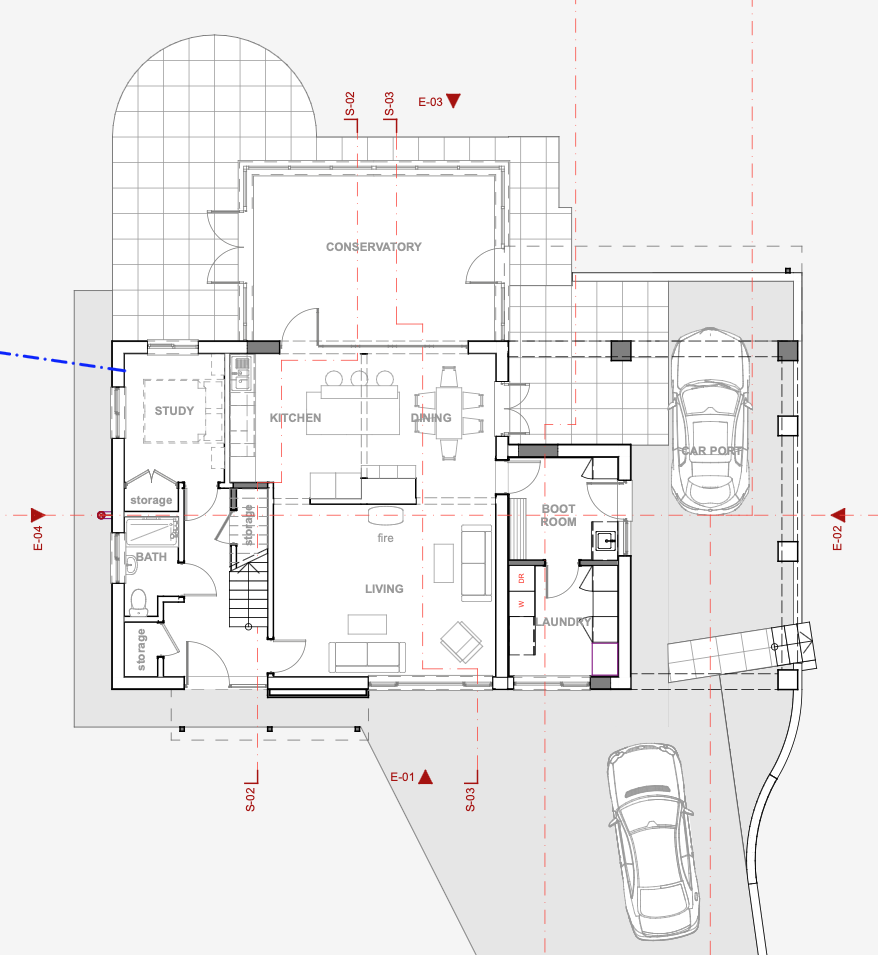
Planning drawings are the set of architectural drawings required to submit a valid planning application to a local planning authority. They show the existing state of a property or site and the proposed changes in sufficient detail for the planning authority to assess the application. A standard set of drawings typically includes a site location plan, a block plan, existing and proposed floor plans, and existing and proposed elevations. More complex projects may also require sections, roof plans, landscaping plans and additional supporting documents.
Planning drawings are not the same as building regulations drawings, which are prepared later in the process and contain the detailed technical information needed to construct the building. Planning drawings are focused on establishing what is proposed and demonstrating that it is appropriate in its setting. They need to be accurate, clearly presented and prepared with an understanding of what the relevant planning authority will be looking for.
Who Needs Planning Drawings?
They are needed by anyone submitting a planning application to a local authority. Here are the most common situations where we prepare them:
Residential clients
Homeowners extending their property: whether a rear extension, side return, two-storey addition or loft conversion, most extensions beyond a certain size require a formal planning application.
Homeowners changing the use of part of their property: converting a garage to living space, creating a separate annexe or adding a new dwelling to a garden plot all typically require planning permission.
Self-builders: anyone building a new home on a plot of land requires planning permission, and a professional set of drawings is essential to a credible application.
Property owners in sensitive locations: properties in conservation areas, listed buildings and areas subject to Article 4 directions often require planning permission for works that would be permitted development elsewhere. We prepare applications for these more sensitive sites regularly.
Commercial clients
Businesses extending or remodelling their premises: most commercial extensions, facade alterations and changes to the external appearance of a building require planning permission.
Change of use applications: converting a commercial building to residential use, or changing between commercial use classes, requires a formal planning application in most circumstances.
Developers and housing associations: new residential developments, housing schemes and mixed-use projects all require detailed drawings as part of the application package.
Community organisations and public sector bodies: schools, community centres, places of worship and public buildings all require planning permission for extensions and alterations, and often benefit from a carefully considered application that addresses community impact and design quality.
Do You Always Need Planning Drawings?
Not always. Many smaller residential works can be carried out under permitted development rights, which allow certain types of development to proceed without a formal planning application. If your project qualifies as permitted development, you may not need planning drawings at all.
However, permitted development rights have specific size limits, conditions and exclusions, and they do not apply in every situation. The following circumstances typically mean planning permission is required even for works that would otherwise be permitted development:
Conservation areas: many permitted development rights are restricted or removed in conservation areas. Extensions, alterations to roofs and changes to windows and doors may all require planning permission.
Article 4 directions: local planning authorities can issue Article 4 directions that remove permitted development rights across specific areas or property types. Bristol City Council has issued Article 4 directions across large parts of the inner city. Some Cardiff neighbourhoods are also affected.
Listed buildings: listed building consent is required for any works that affect the character of a listed building, regardless of whether planning permission is needed. Works to listed buildings almost always require both listed building consent and full planning permission.
Flats and maisonettes: permitted development rights do not apply to flats or maisonettes. All external alterations to flats require planning permission.
New builds: permitted development rights cover very limited new build scenarios. Most new residential and commercial buildings require a full planning application.
Planning conditions: some properties have had permitted development rights removed by condition as part of a previous planning approval. We check the planning history of every site we work on.
If you are unsure whether your project requires planning permission, we can assess your property quickly and give you a clear answer. We are not in the business of recommending planning applications where they are not needed, but we will always tell you when one is worth making for certainty or added value.
Award-Winning Architectural Firm
Founded in 2013 after 20 years at large practices, Dennis Hellyar Architects brings the rigour of a bigger firm with the personal service clients value most. We are registered with the Architects Registration Board and hold Certified Passive House Designer accreditation, making us well-placed to advise on energy performance and sustainability across all project types.
From residential extensions in Pontcanna to a £27M social housing regeneration scheme for Cardiff City Council, our track record speaks for itself. Our Cwrt Parc development won the Best Social Housing Award at the Building Excellence Awards 2020.

Why Our Planning Drawings Get Results
There is no shortage of people who can produce a set of drawings. What matters is whether those drawings are prepared by someone who understands planning as well as architecture, who knows the local authority they are submitting to, and who has the experience to anticipate and address potential problems before they arise.
RIBA Chartered Practice and ARB registered: our professional accreditations are your assurance that our work meets recognised standards of quality and conduct.
Over a decade of planning applications across South Wales and the South West: we have prepared successful applications with Cardiff Council, Vale of Glamorgan Council, City and County of Swansea, Bristol City Council and a range of other authorities across the region.
Experience across project types: from single-storey residential extensions to 106-home regeneration schemes, our planning experience spans the full range of residential and commercial project types and scales.
Award-winning track record: our Cwrt Parc development in Barry required a complex planning application for a challenging steep-hill site. Our Lansdowne Hospital regeneration in Cardiff is one of the city's largest recent housing schemes. Both required thorough, well-prepared applications that addressed complex planning policy in detail.
Honest about outcomes: we tell clients honestly what we think the likely planning outcome is before they commit to an application. If we think a proposal faces significant planning risk, we say so and suggest alternatives. We do not prepare applications we do not believe in.
Clear throughout the process: clients are kept informed at every stage. You will never be left wondering what is happening with your application or who is dealing with it.
Prepared with Local Authority Knowledge
A professional set of drawings is a necessary starting point, but it is not sufficient on its own. What makes the difference between an application that sails through and one that runs into problems is an understanding of how the specific local planning authority thinks, what it prioritises and how it interprets its own policies. That knowledge comes from experience, and it is one of the most valuable things we bring to every application we prepare.
If your property or site is in an area not listed below, get in touch and we can confirm whether we cover your location. We typically work across South Wales and the South West of England.
Cardiff Council
Cardiff Council receives a high volume of planning applications and operates a well-documented set of design policies. The council places particular weight on how proposals relate to the character of the existing street and neighbouring properties, and its conservation area guidance is detailed and consistently applied. We prepare Cardiff applications with a clear understanding of the council's design expectations, its supplementary planning guidance and the way its planning team approaches householder and commercial applications. We also know where pre-application advice from the council is likely to be worth seeking before formal submission.
City and County of Swansea
Swansea's planning authority has its own distinct character and policy framework, and applications that work well in Cardiff do not automatically translate. We understand the City and County of Swansea's approach to residential development, its policies for the Gower AONB, and the specific considerations that apply to applications in Swansea's conservation areas and along the Heritage Coast. For commercial applications in the wider Swansea area, we also have experience with Neath Port Talbot Council's planning policies and processes.
Vale of Glamorgan Council
Vale of Glamorgan Council is the planning authority we work with most regularly, given our studio base in Barry. We have a longstanding familiarity with the council's planning team and its policies across the full range of residential and commercial application types. The Vale has a significant number of conservation areas and a Heritage Coast designation that affects planning decisions along the coastline. We know how the council assesses applications in each of these sensitive contexts and how to present proposals that address its concerns proactively.
Bristol City Council
Bristol City Council has a strong emphasis on design quality, sustainability and contextual sensitivity in its planning assessments. The council's widespread Article 4 directions and its extensive network of conservation areas mean that a higher proportion of residential applications in Bristol require careful preparation and justification than in many other areas. We prepare Bristol applications with a clear understanding of the council's design guide, its conservation area character appraisals and the way its planning team approaches applications in different parts of the city.
What Our Planning Drawings Include
Every planning application is different, and the drawings we prepare are tailored to the specific requirements of your project and the relevant local planning authority. A typical package of drawings from Dennis Hellyar Architects includes:
Site location plan: a scaled map showing the application site in its wider context, with the site boundary marked. Required for all planning applications.
Existing block plan: a scaled plan showing the current layout of the site, including the footprint of existing buildings and their relationship to boundaries and neighbouring properties.
Proposed block plan: a scaled plan showing how the site will look after the proposed development, making clear what is changing and what is staying the same.
Existing floor plans: scaled drawings of the current internal layout of the building, floor by floor, showing room arrangements, wall positions, openings and key dimensions.
Proposed floor plans: scaled drawings of the proposed internal layout following the development, clearly showing all alterations and additions.
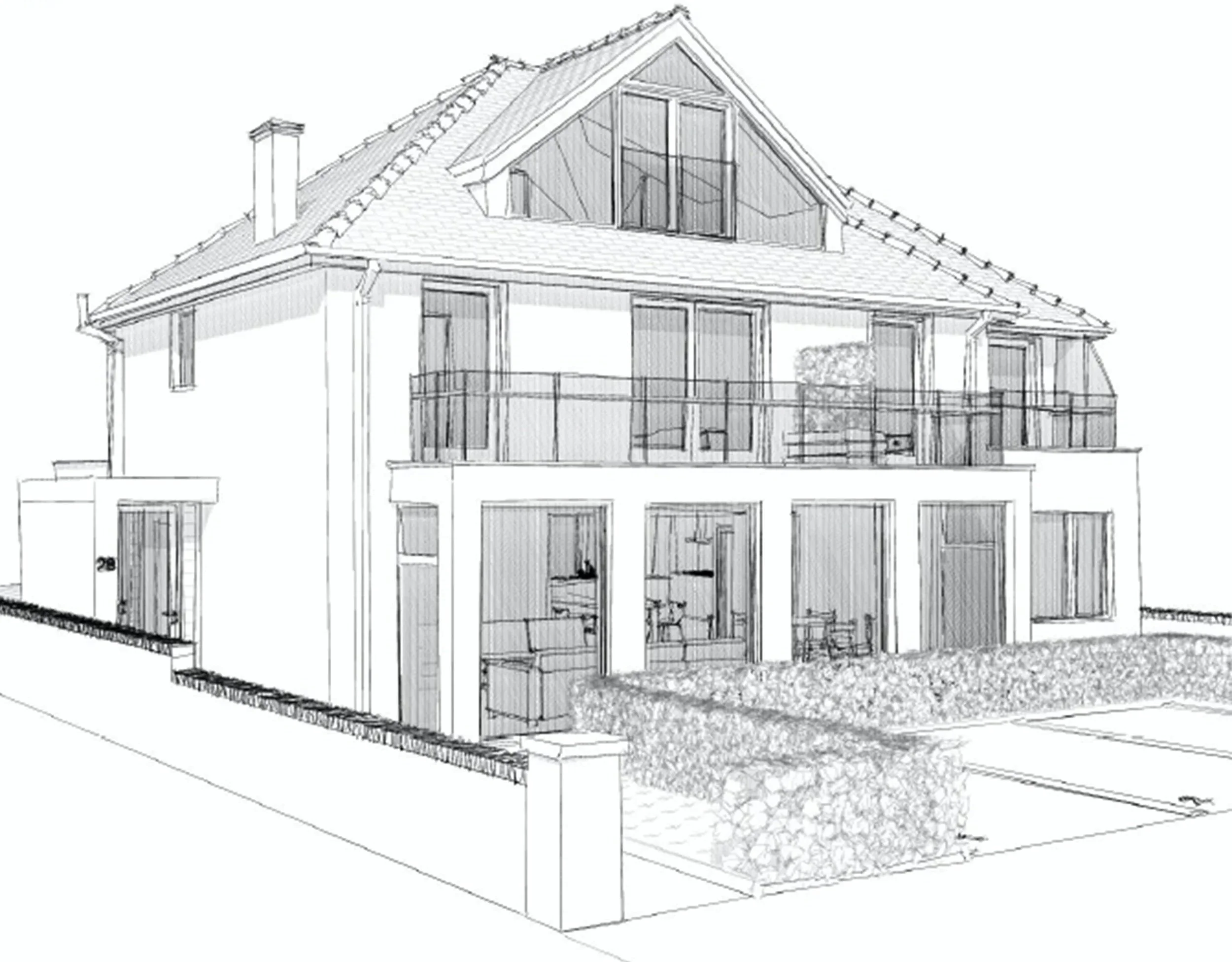
Existing elevations: scaled drawings of the exterior faces of the existing building, showing materials, window and door positions, roof form and relationship to ground level.
Proposed elevations: scaled drawings of all affected exterior faces following the proposed development, clearly annotated with materials and key dimensions.
Sections where required: for more complex projects or where levels change significantly, sections through the building and site to show the relationship between internal spaces and external ground levels.
Design and access statement: a written document required for most larger applications explaining the design approach, how the proposal responds to its context and how access has been considered. We prepare these as part of our standard service where required.
Supporting planning statements: for complex applications or where specific policy issues arise, we prepare additional written supporting material to address the planning authority's likely concerns directly.
Liaison with the local planning authority: we manage the relationship with the planning authority throughout the application process, responding to queries, submitting additional information where requested and keeping you informed at every stage.
The exact package of drawings and documents required for your application will depend on the nature and scale of your project and the requirements of the specific local planning authority. We confirm what is needed before we begin and do not prepare unnecessary drawings that add cost without adding value.
How the Planning Application Process Works
If you have not been through the planning process before, here is a plain-language overview of how it typically works when you instruct Dennis Hellyar Architects to prepare and submit your application:
Step 1: Design and drawing preparation
We develop the design with you and prepare the full set of drawings and supporting documents required for a valid application. We confirm with the relevant local planning authority what is required before we begin, so nothing is missed and nothing unnecessary is prepared.
Step 2: Pre-application enquiry (where relevant)
For complex or sensitive applications, we may recommend making a pre-application enquiry to the local planning authority before formal submission. This is an optional paid service offered by most councils that allows you to get informal feedback on a proposal before committing to a formal application. We advise on whether this step is likely to be worthwhile for your specific project.
Step 3: Submission and validation:
We submit the application on your behalf through the relevant planning portal, paying the application fee and confirming all required documents are included. The local authority validates the application, usually within a few days, and assigns it a case officer and reference number.
Step 4: Consultation and assessment period
Once validated, the application enters the statutory assessment period. For most householder applications in Wales this is 8 weeks; in England it is typically 8 weeks for householder applications and 13 weeks for larger developments. During this time the planning authority consults neighbours, statutory consultees and its own internal departments. We monitor the application throughout this period and respond to any queries or requests for additional information from the case officer.
Step 5: Decision
The planning authority issues its decision in writing. If permission is granted, it will be subject to conditions that set out what must be done before or during construction. We review the decision and conditions with you and advise on any implications for the project. If permission is refused, we review the reasons with you and advise on the options, including resubmission with amendments or appeal.
Step 6: Appeal (if required)
If a planning application is refused and we consider the refusal to be unreasonable, you have the right to appeal to the Planning Inspectorate. We can prepare and submit a planning appeal on your behalf, though we always aim to prepare applications thoroughly enough that appeal is not necessary.
Throughout the process, we keep you informed at every stage. You will always know where your application is, what is happening and what the next step is.
Ready to get started? An initial conversation with our architects costs nothing and will give you a much clearer picture of the process.
Technical Drawings and Specifications
Getting planning permission is only the first stage. Once your design is approved, it needs to be developed into the detailed technical information required to actually build it. We prepare technical stage drawings and specification documents that take your project from an approved planning scheme through to a buildable set of instructions for the building regulations, tender and construction process.
We prepare technical drawings and specifications as part of our Full Architectural Service, giving you continuity from the very first planning sketch through to a finished building. Working with the same team throughout means nothing gets lost in translation between design intent and what actually gets built.
Building Regulations drawings
Detailed technical drawings showing how the building will meet the requirements of the Building Regulations, covering structure, fire safety, insulation, ventilation, drainage and accessibility. These are submitted to building control or an approved inspector and are a legal requirement before work begins on site.
Tender drawings and documents
A complete package of drawings and specifications prepared so that contractors can price your project accurately and on a like-for-like basis. We can manage the tender process on your behalf, comparing quotes and helping you select the right contractor for your project and budget.
Specification documents
Written documents setting out the materials, products and standards of workmanship required for the project. A clear specification reduces ambiguity on site, helps contractors price accurately and gives you a reference point if quality or materials are ever in question.
Construction drawings
Detailed drawings used on site during the build, showing the information contractors and tradespeople need to construct the project correctly, including junction details, setting-out information and any specialist design elements.
Common Questions
-
A standard set of planning drawings typically includes a site location plan, an existing and proposed block plan, existing and proposed floor plans, and existing and proposed elevations. More complex applications may also require sections, roof plans and landscaping drawings. Most applications also require a completed application form and, for larger projects, a design and access statement. The exact requirements depend on the nature of your project and the local planning authority you are applying to.
-
The cost of planning drawings depends on the size and complexity of the project, the number of drawings required and the level of supporting documentation needed. We provide a clear, fixed fee proposal before we begin, so you know exactly what you are committing to. Get in touch to discuss your project and we will give you a clear indication of costs.
-
The time needed to prepare planning drawings depends on the complexity of the project and how quickly design decisions can be agreed. For a straightforward residential extension, we can typically prepare a complete set of planning drawings within three to four weeks of instruction. More complex or large-scale projects will take longer. We give you a clear programme at the outset and work to meet it.
-
A design and access statement is a written document that accompanies a planning application and explains the design thinking behind the proposal: how it responds to its context, why the materials and form have been chosen and how access has been considered. It is required for most larger applications and for any application in a designated area such as a conservation area or World Heritage Site. We prepare design and access statements as part of our standard planning drawings service where required.
-
Yes, anyone can submit a planning application. However, the quality of the drawings and supporting documents has a direct impact on the outcome. Poorly prepared drawings are a common reason for applications being delayed, returned as invalid or refused. Working with a RIBA chartered architect who understands the local planning authority significantly improves the quality of your application and your chances of approval.
-
If your application is refused, the decision notice will set out the reasons for refusal. In many cases it is possible to address those reasons and resubmit, either immediately or after further design work. You also have the right to appeal to the Planning Inspectorate within a set time period. We review refused decisions with clients and advise on the most appropriate next step, whether that is resubmission, appeal or an amended design.
-
Planning drawings focus on what is proposed and whether it is appropriate in its setting. They are submitted to the local planning authority and result in a planning decision. Building regulations drawings are prepared later in the process and contain the detailed technical information needed to construct the building safely: structural calculations, insulation specifications, drainage layouts and so on. They are submitted to the local authority's building control department or an approved inspector. The two sets of drawings serve different purposes and are assessed by different parts of the council.
If your question is not here, please visit our dedicated residential FAQs or commercial FAQs pages for more information.